The Jackal's assumed identities and disguises
The Day of the JackalThe Jackal’s assumed identities and disguises turn appearance into an operational resource: forged papers, changed hair and eye color, altered height and weight, and carefully chosen clothing let him pass as several different men while carrying out the assassination plot and escaping the police. The sequence is more than a set of aliases. Each persona is prepared for a particular encounter, then discarded before investigators can make its records and visible details converge on him.
Identity as a method
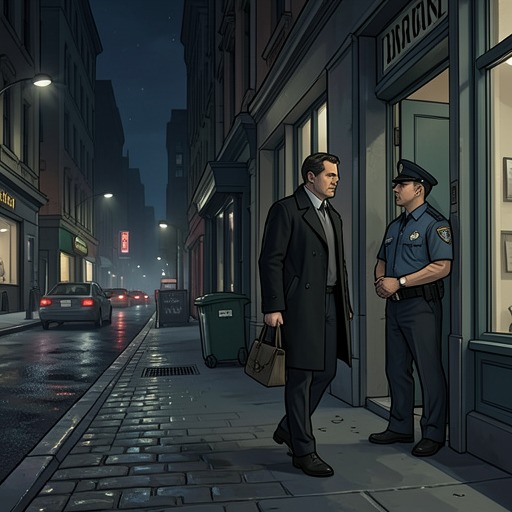
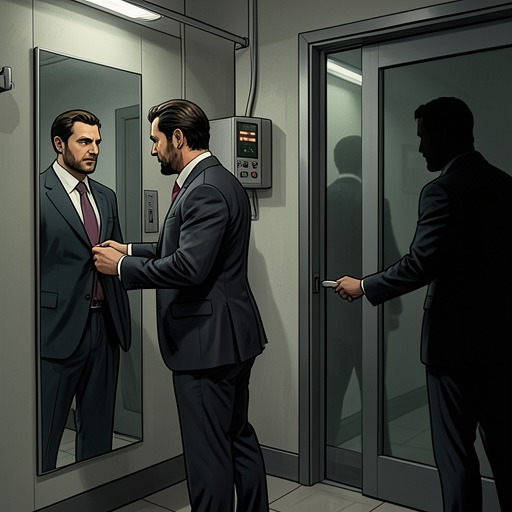
The police eventually reconstruct the central chain as Charles Calthrop becoming Alexander Duggan, Duggan becoming Pastor Per Jensen, and Jensen becoming Marty Schulberg. Claude Lebel argues that a professional assassin who has avoided official police files must have worked under false names and appearances; the comparison between photographs shows that the Jackal can transform himself substantially. He can add height with raised heels, lose several kilos, change his eye color with contact lenses, and alter his hair with dye. Lebel treats that demonstrated capacity as a warning: investigators cannot assume the man has only one alternate identity.
The Jackal’s anonymity works in two directions. It conceals him from officials, but it also means that a description alone cannot reliably identify him: his apparent build, coloring, age, nationality, and social role can all be changed. His own painstaking preparation is set against the police’s need to assemble scattered records and observations. The more identities he can inhabit, the more important it becomes for investigators to compare photographs, dates, passport details, and travel records rather than trust any single appearance.
Forged papers and the Duggan persona
At a London studio, the Jackal examines three cards laid out on a table used as a prop for portrait photographs. One is a driving licence for Alexander James Quentin Duggan of London, issued for a specified period and bearing a plausible licence number and local-authority wording. He judges the forgery good enough for his purposes. Another is a French identity card for André Martin, a fifty-three-year-old born in Colmar and resident in Paris. Its aged portrait gives him iron-grey hair and a working man’s look; the card itself is stained and dog-eared. A further specimen uses a subtly different portrait, with altered shirt tone and retouched stubble, so the pictures appear to have been taken months apart. The differences are part of the credibility: documents supposedly renewed at different times should not look like copies made in one sitting.
Duggan’s identity also has to withstand ordinary checks, not merely visual inspection. The real Duggan had died as a small child, and his birth date fixed the age that could be claimed. The Jackal therefore appears as thirty-four on the passport, although Charles Calthrop is thirty-seven; the discrepancy is plausible enough, the police judge, that an observer would be more likely to trust the document than question it. The records later show Duggan entering France on the Brabant Express from Brussels on July 22 and leaving on the Etoile du Nord Express on July 31. A hotel card places him near the Place de la Madeleine during the intervening period. These details give the invented man a traceable itinerary—and give the investigators a trail to pursue.
Pastor Jensen and the escape from the château
After killing the Baroness, the Jackal packs away the rifle components, his military greatcoat, and the soiled clothes associated with André Martin, taking care not to disturb the papers in the suitcase. He then prepares the Jensen appearance in stages: he washes and shaves, trims two inches from his long blond hair, dyes it iron-grey, and brushes it into the style shown in Pastor Jensen’s passport. Blue-tinted contact lenses complete the altered face. He cleans the basin, removes the traces of the transformation, and dresses in clothes bought in Copenhagen, adding a black bib and dog collar beneath a conventional black suit. The Danish passport and money go into his inside pocket; a Danish book on French cathedrals and his washing things go into the hand-grip.
The performance carries him from the château into Paris as a plausible clergyman, but he assumes the identity is temporary. When he reaches a small hotel on the Quai des Grands Augustins, Lebel’s investigation is already advancing. The Jackal returns towards the Gare d’Austerlitz, deposits the suitcase containing the rifle and André Martin’s French clothes in left luggage, and keeps the baggage associated with his next change. At a cheap hotel, he uses a registration card the clerk fails to check against the passport. That lapse lets him register under neither Per Jensen nor the passport’s identity, while his outward appearance still belongs to the departing pastor.
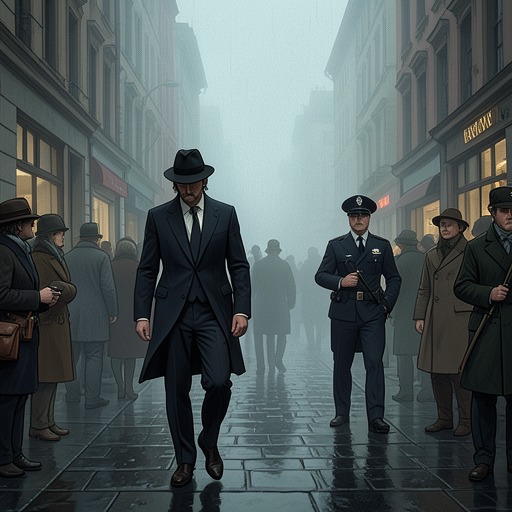
In the room, he washes out the grey dye with solvent and recolors his blond hair chestnut brown. The blue lenses remain, but gold-rimmed spectacles give way to Marty Schulberg’s heavy-rimmed glasses. He replaces the clerical suit with sneakers, jeans, a T-shirt, and a windcheater, and puts Jensen’s clothes and passport away. He hides the wardrobe key down the bidet and leaves by the fire escape. The transformation is designed to leave evidence behind in fragments: the Jensen costume and passport are concealed, the rifle remains elsewhere, and the Jackal moves into the Latin Quarter dressed as an American student from Syracuse.
From disguise to police evidence
The identities are effective but not permanent. The Jackal expects Lebel to expose Pastor Jensen quickly and gives Marty Schulberg no more than a day before anticipating further scrutiny. At the Ministry, officials acknowledge that the assassin has already changed identity three times, from Calthrop to Duggan, Duggan to Jensen, and Jensen to Schulberg. The admission marks a change in the manhunt: the police now have a name, description, passport number, and nationality for Schulberg, and distribute the details across the security apparatus. A disguise that had separated the assassin from the records has become a sequence of transitions that investigators can state and circulate.
Lebel’s response to the possibility of another identity is to treat transformation itself as part of the suspect’s known capabilities. His reasoning is supported by the visible alterations documented in the photographs and by the Jackal’s demonstrated habit of preparing elaborate papers. When Lebel orders a search around the car found near Ussel, he gives officers not just a general description but practical details: a tall, English-born man speaking good French, carrying three suitcases and a hand-grip, with cash and the appearance of someone who has slept rough. The instruction to search farmhouses, village shops, cafés, hotels, and woodcutters’ shacks recognizes that the disguised fugitive may have to interact with ordinary people while moving through the countryside.
The final André Martin appearance brings the earlier forged identity into the open again. At the Paris ceremony perimeter, the Jackal approaches as an old war veteran carrying two cards for the same French citizen: one identifies André Martin, aged fifty-three, born at Colmar and resident in Paris; the other bears the designation Mutile de Guerre. Their photographs show the same man at different times. When Pierre Valremy asks him to remove his beret, the Jackal presents a face that matches the cards, with grey, disordered hair and the convincing marks of a rough shave. The disguise has shifted from the neat cleric and youthful student to an apparently injured veteran whose role explains his movements and appearance. Yet the physical transformation cannot guarantee success: the papers persuade Valremy to return them, but the attempt to reach the President still depends on passing the security cordon.
Narrative significance
The disguises make the manhunt a contest between personal preparation and institutional comparison. The Jackal controls what an observer sees in a single encounter; Lebel and his colleagues work across time, matching passport numbers, hotel registrations, photographs, border records, and descriptions. Each new persona temporarily resets the visible clues, while the accumulated paperwork gives the police a way to connect the resets. The sequence therefore makes identity both the Jackal’s strongest tool and the source of his vulnerability: he can change his face and role, but every change requires materials, documents, luggage, and a credible passage from one life to the next.